DLTK's Educational Crafts for Kids
Phases of the Moon Craft
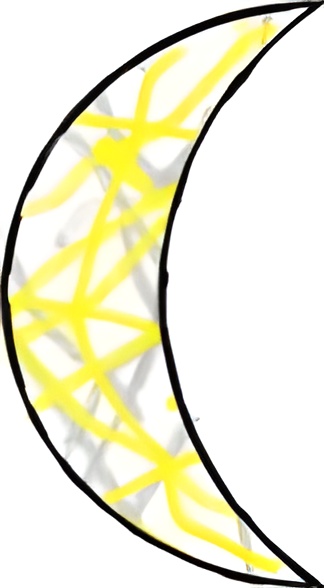 Pick your favorite phase of the moon to decorate OR make all of them
and hang them on the bulletin board or fridge as they occur.
Pick your favorite phase of the moon to decorate OR make all of them
and hang them on the bulletin board or fridge as they occur.
I have provided 3 suggestions for painting the moon for different age levels. The age levels are just my suggestions -- depending on the child's experience with art projects and/or the number of children you're supervising during the project, you can adjust the age levels.
Materials:
- paper,
- printer,
- scissors,
- tempra or poster paint (two or three different colors) -- we used grey and yellow
One of:
- age 2 to 4: 3 plastic spoons, 9 marbles, 3 empty containers (margarine containers) and a cardboard box lid (a cardboard lid with sides at least 2 inches high)
- age 4 to 6: 1 foot long pieces of string or wool (thicker is better -- you'll need one for each color of paint) and 3 paper plates (one for each color of paint)
- age 6 to 8: kitchen sponge or sea sponge chopped and 3 paper plates
Learning Points:
- You can just decorate your favorite phase of the moon, but I like to do all of the templates (except the full moon) twice and hang them up in the order they appear during the month (see below for what I mean -- to get the last three, you just turn the first three upside down). Then check out a calendar with your children to see when each phase will happen during the month. Make a point of peeking at the night sky to see the changes happen and compare them to your "phases of the moon art"

crescent, half, gibbous, full, gibbous, half, crescent
- Question: Which one of the phases of the moon is missing? Answer: The new moon -- this is when the moon cannot be seen (it comes at the very beginning of the sequence). After the final crescent, the whole cycle starts over again with another new moon.
- Note: The period where the moon is getting larger each night (towards full) is called "waxing". The period where the moon is getting smaller each night is called "waning".
- Question: How many days does it take for a full cycle of the moon's
phases? Answer: 29.5 days
- Advanced bit: I'm going to share this because I know I'll get emails telling me the moon's orbit takes 27 days not 29.5 so shouldn't the phases take 27 days -- the answer is no and here's why: It is true that the moon actually only takes 27.3 days to complete an orbit around the earth so why is a moon's cycle 29.5 days? It's because the earth is orbiting the sun at the same time and it's the sun's light, seen from earth, reflecting off the moon that causes the phases of the moon. The fancy name for the 29.5 days is the "synodic period" (this is an astronomy term that refers to the period of time it takes for any object in the solar system to return to the same position relative to the Sun as seen from earth) -- I wouldn't share this with the kids, it's too complicated, but it's kind of neat to know... OK! back to a preschool level *grin*
Directions for the craft:
- Print the template of choice (see bottom of this page for your choices)
- Paint the template using one of the techniques described below.
- Let dry.
- Cut out the template and hang it on the fridge or bulletin board.

Technique 1 (age 2 to 4) - marble painting
- Fill each margarine container about 1 inch deep with different color paint.
- Put two or three marbles in each container.
- Let the children, stir the marbles around with a plastic spoon so they're coated with paint.
- Put the template inside the cardboard box lid
- Let the children scoop the marbles out of the containers and put them inside the box lid with the template
- Let the children gently tilt the box lid so the marbles roll around on the
template leaving tracks of paint on the image.
- supervise this stage to ensure they don't tilt too far and dump the paint marbles out on the floor
- Repeat as needed.

Technique 2 (age 4 to 6) - string painting
- Put paint onto paper plates (fill them up quite well)
- Cut a piece of string or wool about a foot long
- Dip the string in the paint (keep the ends dry so you can hold them).
- Pull the string taught and put onto the template
- Repeat to make a number of string lines going all different directions -- use two or three colors to make it more exciting
 Technique 3 (age 6 to 8) - sponge painting
- Put just a little paint on paper plates
- Have the children dip a sponge into one of the colors and dab off the excess on a dry spot of the paper plate or a paper towel.
- Dab the sponge onto the template to make a textured look.
- Repeat with other colors.
- When I do this project, I like to provide two complimentary colors of
paint and let the children mix their own shades by blotting them together
with their sponge
- with Tasha, I gave her white, blue and black to make a full moon -- she blotted the white and blue together first and then added a bit of black to her sponge)
- she had as much fun blotting together shades of color on the paper plate to get the perfect one as she did making her moon (this enjoyment of color experimentation is why I ranked this the oldest technique)
- I like to use one piece of sponge for all the colors so you get some
nice blending.
Printing your Templates:
- Close the template window after printing to return to this screen.
- Set page margins to zero if you have trouble fitting the template on one page (FILE, PAGE SETUP or FILE, PRINTER SETUP in most browsers).
Same sized Templates (the crescent moon, etc seem a little small, but it's for those of you who want to make all the phases of the moon and hang them side by side -- so it doesn't look like the moon shrinks as it approaches full)
Templates: crescent half gibbous full
Big as possible Templates (choose these if you're just making your favorite phase)
Templates: crescent half gibbous full
Print friendly version of these instructions